Three Documents
Not code. Just organized thinking.
The Seed
Everything else grows from this.
The Interview Method
The Interview Prompt
Ask me one question at a time so we can develop a thorough, step-by-step spec for this idea. Each question should build on my previous answers, and our end goal is to have a detailed specification I can hand off to a developer. Let's do this iteratively and dig into every relevant detail. Remember, only one question at a time.
Here's the idea: [describe your idea]
Keep the Scope Tight
The AI will get excited. Don't let it.
For the Interview
ChatGPT Auto Mode
Quick answers when simple. Deep thinking when outputting the spec.
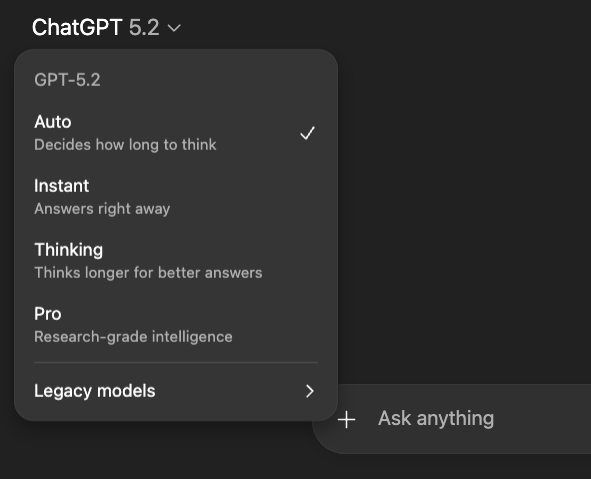
Optional
Double-Check with a Smarter Model


Where the Magic Happens
Copy-paste prompts that do the coding for you.
The Blueprint Prompt
Draft a detailed, step-by-step blueprint for building this project. Then, once you have a solid plan, break it down into small, iterative chunks that build on each other. Look at these chunks and then go another round to break it into small steps.
Review the results and make sure that the steps are small enough to be implemented safely with strong testing, but big enough to move the project forward. Iterate until you feel that the steps are right sized for this project.
From here you should have the foundation to provide a series of prompts for a code-generation LLM that will implement each step in a test-driven manner. Make sure we're not using mock data, but real data when testing and real calls to APIs when relevant.
Prioritize best practices, incremental progress, and early testing, ensuring no big jumps in complexity at any stage. Make sure that each prompt builds on the previous prompts, and ends with wiring things together. There should be no hanging or orphaned code that isn't integrated into a previous step.
Make sure and separate each prompt section. Use markdown. Each prompt should be tagged as text using code tags. The goal is to output prompts, but context is important as well.
[Paste your spec here]
Phases with Ready-Made Prompts
Testing is Baked In
The AI validates its own work.
Code
Tests
Correct
Keeps Everything on Track
That's it.
AI Memory Fades
The longer the session, the more it forgets.
The To-Do List Solves This
AI always knows where it is in the project.
The Process > The Tool
But here are my recommendations anyway.
Deep Dive
I Made a Video on This

Best for Beginners
The Model Matters
Different strengths for different tasks.
Errors Will Happen
Persistence wins. Then embed the lesson.
Knowledge Cutoff Problem
AI defaults to old versions of new APIs.
The Fix
Embed lessons into your project files.
Gemini 2.5 Flash
API calls...
→ Use Gemini 3 Flash
→ New endpoint format
→ Updated auth method
Future sessions auto-correct. Same mistake, never again.
The Embed Lesson Prompt
We figured out how to fix this. Now I need you to update the claude.md file (or .cursor/rules or agents.md depending on the tool) with this lesson.
Write it briefly and information-dense. I want future AIs to see this and never make this mistake again.
Bigger Chunks Now
New models can handle entire phases at once.